+19y
1998
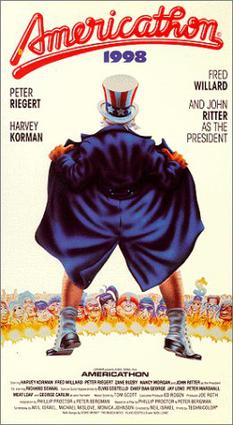
Americathon ↗ Wikipedia
Vision from 1979
Dir. Neal IsraelGermanyEnglishIMDb 4.686 min
dystopiacorporationseconomicsmediasatireenergy crisis
In the speculative vision of 1998, the United States has reached a point of total economic and resource exhaustion. The nation has completely run out of oil, forcing the population to repurpose their stationary automobiles as makeshift housing while commuting via bicycles, roller skates, and jogging. This post-fuel dystopia is defined by a devalued currency where paper money is worthless and all remaining commerce is conducted in gold coins.
Societal dynamics revolve around a bankrupt federal government led by President Chet Roosevelt, a New Age figure who operates out of a sublet condo in California rather than the White House. The film depicts an Earth-centered crisis where the U.S. has lost its superpower status to emerging global forces: China has embraced capitalism and decimated the Soviet Union, while Vietnam has become a dominant cultural and economic juggernaut. Domestic stability is further threatened by massive sovereign debt owed to a private conglomerate, which seeks to foreclose on the entire country and return the land to its original Indigenous owners.
Despite its absurdist tone, the film is noted for several eerie geopolitical hits, specifically the rise of China as a capitalist superpower and the eventual collapse of the USSR. Its depiction of the ubiquity of reality television—represented by the televised fund-raising marathon and game shows like "The Schlong Show"—parallels the actual media evolution of the early 2000s. While the film correctly anticipated the massive growth of multinational corporations like Nike, its central premise of the U.S. completely running out of oil by 1998 proved to be an overestimation of the 1970s energy crisis.