+25y
2000
Death Race 2000 ↗ Wikipedia
Vision from 1975
Dir. Paul BartelUnited StatesEnglishIMDb 6.280 min
dystopiatotalitarianismmedia satirecarsreality tvfascismviolence
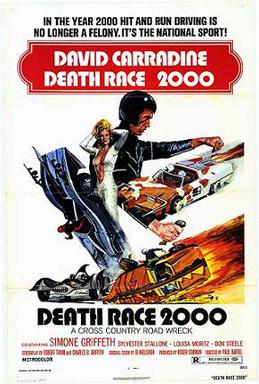
In the aftermath of the "World Crash of '79," the United States has transitioned into a totalitarian regime known as the United Provinces. To suppress civil unrest and distract the populace from economic ruin, the government, led by a charismatic and religious despot known as "Mr. President," institutes the Transcontinental Road Race. This annual event is a cross-country murder spree where drivers earn points for striking pedestrians, with higher scores awarded for the most vulnerable citizens, such as the elderly and infants. The world is depicted as a tacky, hyper-saturated landscape where violence is the primary currency of entertainment.
The film portrays a society deeply affected by hyper-mediatization and surveillance capitalism, where every move of the racers is broadcast to a bloodthirsty public. The political dynamic is one of extreme populism; the regime maintains power by blaming all internal failures—including the acts of an underground resistance movement led by Thomasina Paine—on the French. This alternate timeline diverges sharply from reality in 1979, resulting in a world where the American flag has been redesigned and the country is ruled by martial law under a thin veneer of televised pageantry. Earth serves as the central political hub of this decay, with major cities like New York and New-Los Angeles functioning as the start and end points for the ritualized slaughter.
While the literal prediction of a state-sanctioned murder race did not manifest by the year 2000, the film is cited as a prescient look at the rise of reality television and the gamification of extreme content. Analysts have noted parallels between the film's "Mr. President" and modern populist leaders who utilize media spectacle to bypass traditional democratic norms. The film's depiction of televised bloodsports prefigures the cultural obsession with increasingly shocking "reality" formats seen in the early 21st century. Furthermore, its themes regarding the parasitic relationship between government and big business accurately mirror contemporary concerns about the industrialization of entertainment as a means of social control.