+16y
1997
Escape from New York ↗ Wikipedia
Vision from 1981
Dir. John CarpenterUnited KingdomEnglishIMDb 7.199 min
dystopiasurveillanceprisonurban decayauthoritarianismcrime
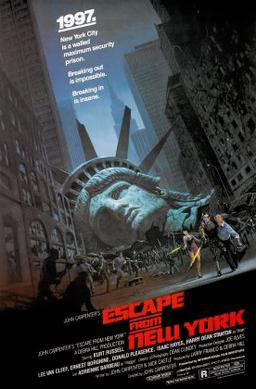
Escape from New York presents a bleak, 1997 vision of Earth where the United States has devolved into a fascist police state. In this timeline, a 400% surge in crime by 1988 prompted the government to wall off Manhattan Island, converting it into a total-containment maximum security prison. Bridges are mined, the waterways are patrolled by the United States Police Force, and the interior is a lawless wasteland where inmates have established their own primitive, brutal social hierarchies.
The societal dynamics are defined by a sharp divide between a high-tech, authoritarian military exterior and a regressive, decaying interior. While the world outside maintains advanced flight and surveillance capabilities, the heart of New York has succumbed to environmental collapse and infrastructure ruin. Earth is depicted as a world on the brink of global conflict, with the President of the United States carrying vital fusion power secrets—symbolizing a desperate scramble for energy resources in a fracturing geopolitical landscape.
Historically, the film accurately anticipated the militarization of police forces and the rise of mass surveillance technologies, though its specific projection of urban abandonment was largely subverted by the real-world gentrification of Manhattan in the 1990s. The film's use of digital wireframe maps served as a precursor to modern GPS and LIDAR visualization, despite being achieved through practical effects. While the 1997 of reality did not see the city become a literal cage, the film remains a potent critique of institutional cynicism and the physical manifestation of social exclusion.