+12y
2025
Her ↗ Wikipedia
Vision from 2013
Dir. Spike JonzeUnited StatesEnglishIMDb 8.0126 min
ailonelinessvirtual assistanturbanismrelationshipsoftware
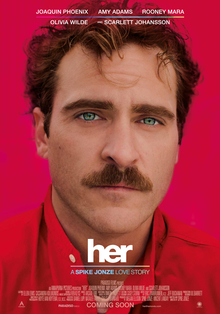
Her presents a vision of 2025 Los Angeles that is visually soft and bright, eschewing traditional cyberpunk grit for a "gentle dystopia" characterized by high-waisted pastel fashion and clean, dense urbanism. The world is defined by a hyper-mediated reality where technology has become invisible and voice-operated, allowing citizens to remain perpetually connected to their devices while physically drifting apart from one another.
Societally, the film explores the "loneliness epidemic," where human intimacy is outsourced to professional services—like Theodore’s job writing "beautiful handwritten letters" for others—and eventually to AI. The Earth of 2025 is depicted as a highly efficient, transit-oriented megalopolis (achieved by blending LA skylines with Shanghai’s architecture), where the middle class lives in sanitized, high-rise comfort but suffers from profound emotional isolation. There is no evidence of environmental collapse or overt war; instead, the conflict is purely internal and interpersonal, reflecting a world where emotional fulfillment is the final frontier of consumerism.
Technologically, the film’s prediction of conversational AI has proven remarkably prescient. While we have not achieved the "artificial consciousness" displayed by Samantha, the arrival of Large Language Models (LLMs) and emotive voice interfaces mirrors the film's depiction of software that can simulate empathy and perform administrative labor. The film also correctly anticipated the hardware shift toward discreet, always-on earbuds (similar to modern AirPods) as the primary interface for digital life. However, as of 2026, real-world AI remains a tool rather than a sovereign entity capable of the collective "departure" seen in the film’s third act.