+20y
2005
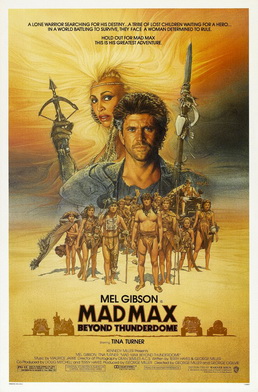
Mad Max: Beyond Thunderdome ↗ Wikipedia
Vision from 1985
Dir. George Miller; George OgilvieAustraliaEnglishIMDb 6.2107 min
dystopiapost-apocalypticenergy crisistribalismresource scarcity
Set in 2005, twenty years after the events of The Road Warrior, the film depicts a post-nuclear Australia where the remnants of humanity have transitioned from chaotic scavenging to the early stages of re-establishing organized society. The world is a scorched wasteland where the primary currency is trade and the most precious resource is energy, as traditional fossil fuels have been completely exhausted following a global resource war.
The societal center, Bartertown, operates as a cynical mirror of modern commercialism, governed by strict laws and powered by "Underworld"—a subterranean refinery. This facility represents a desperate technological pivot, using methane harvested from pig waste to generate electricity. This dynamic highlights a shift from the previous films' focus on kinetic road-warfare to a more sedentary, political struggle over infrastructure control. Meanwhile, a divergent society of children—descendants of a 747 plane crash—lives in a desert oasis, preserving a fragmented, mythologized version of the "High Scanty" (pre-collapse) world through oral tradition.
The film’s central prediction involves the total collapse of the petroleum-based economy and the resulting move toward unconventional, often grueling, energy sources. While the real 2005 did not see a nuclear winter or pig-manure power grids, the film correctly identified Peak Oil concerns that peaked in the mid-2000s and the rising importance of methane as a viable (though here exaggerated) biofuel. Furthermore, the gladiatorial justice system of the Thunderdome serves as a precursor to modern critiques of "spectacle as distraction" in decaying political systems, and the depiction of radioactive water scarcity mirrors contemporary environmental anxieties regarding groundwater contamination and resource depletion.