+12y
1999
Prince of Darkness ↗ Wikipedia
Vision from 1987
Dir. John CarpenterUnited StatesEnglishIMDb 6.7102 min
dystopiareligionquantum mechanicspossessiontime travelapocalypse
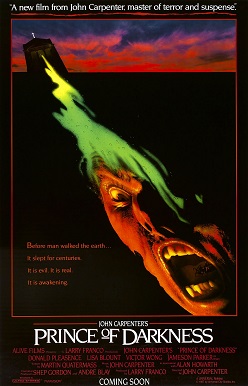
Prince of Darkness presents a 1999 Los Angeles that looks indistinguishable from the late 1980s, serving as a backdrop for a metaphysical siege. The world is not defined by flying cars or neon skylines, but by an encroaching sense of cosmic dread where the boundaries between scientific reality and ancient superstition dissolve. The story centers on an abandoned church in a derelict section of the city, which becomes ground zero for a potential end-of-the-world event as a sentient, liquid embodiment of "anti-matter" evil begins to awaken.
The film’s dynamics revolve around the collision of quantum physics and theology. In this timeline, the Catholic Church is revealed to be a clandestine scientific organization that has spent centuries guarding a physical canister of liquid Satan. Unlike traditional horror, the "demonic" is treated as a biological and physical phenomenon—a virus-like substance that alters human DNA and a consciousness that exists in a mirror-image anti-universe. Earth is depicted as a vulnerable point in a larger, indifferent multiverse, where human logic and faith are both revealed to be inadequate shields against fundamental cosmic forces.
The film’s most distinct predictive element is the dream transmission, a recurring grainy video signal sent back in time via tachyons (particles that travel faster than light). While the real 1999 did not see the advent of time-displaced warning broadcasts, the film accurately anticipated the aesthetic of low-fidelity digital or analog-glitch video that would later dominate early internet culture. Furthermore, the film's suggestion that mathematics and physics could eventually "prove" the existence of what was once considered supernatural reflects modern theoretical discussions regarding the simulation hypothesis and multi-dimensional physics, even if the film's specific conclusion—that Satan is a jar of green goo—remains firmly in the realm of speculative fiction.