+17y
1970
Project Moonbase ↗ Wikipedia
Vision from 1953
Dir. Richard TalmadgeUnited StatesEnglishIMDb 3.363 min
space travelcolonizationsurveillancefemale presidentorbital stationespionage
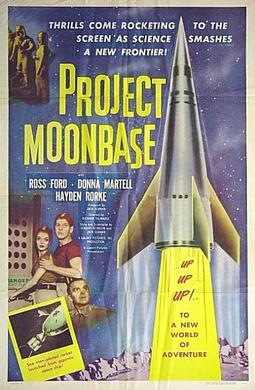
Project Moonbase presents a vision of 1970 where the United States has successfully established a massive wheel-shaped space station in Earth's orbit and is actively preparing for lunar colonization. The world is defined by a tense Cold War dynamic, though the primary adversary remains unnamed, referred to only as a "foreign power" seeking to undermine American celestial dominance. Earth appears as a unified but fragile political center, where the preservation of the "Free World" justifies a massive, militarized push into the cosmos.
The film’s technological landscape is characterized by a mix of high scientific rigor and budget-constrained aesthetics. It depicts a future where space habitation is routine, featuring an orbital station that serves as a transit hub for shuttle rockets. A notable societal dynamic is the elevation of women to high-ranking roles; the United States is led by a female President, and the lunar mission is commanded by Colonel Briteis. However, this progress is undercut by persistent 1950s social mores, as the female commander is often depicted as emotionally volatile and ultimately subservient to her male subordinates in moments of crisis.
In terms of specific predictions, the film was remarkably prescient regarding cordless communication—depicting handheld wireless phones—and the development of orbital infrastructure similar to the later Skylab or ISS. While the 1970 timeline for a permanent moon base was overly optimistic, the film’s depiction of "magnetic shoes" for walking in microgravity and the use of split-screen visuals to show multi-surface movement anticipated modern sci-fi tropes and actual EVA (Extravehicular Activity) challenges. The scientific realism attempted by co-writer Robert A. Heinlein notably includes the physics of orbital maneuvering, though the physical depiction of the lunar surface remained more stylized than realistic.