+43y
2018
Rollerball ↗ Wikipedia
Vision from 1975
Dir. Norman JewisonUnited KingdomEnglishIMDb 6.5125 min
dystopiacorporationssportsurveillanceclass dividemediaauthoritarianism
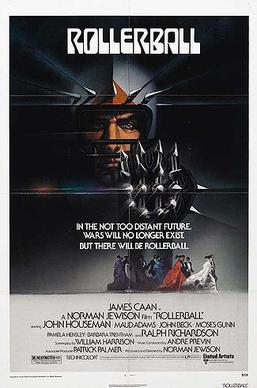
In the year 2018, the world of Rollerball has transitioned into a global corporatocracy where traditional nations have dissolved into six specialized monopolies: Energy, Transport, Food, Housing, Luxury, and Communications. This future is depicted as a disphoric utopia; while war, poverty, and hunger have been eradicated, they have been replaced by a rigid social hierarchy and the total surrender of individual autonomy to corporate overlords. The populace is kept in a state of passive compliance through a combination of luxury goods, mood-altering drugs, and the hyper-violent titular sport, which serves as a cathartic outlet for aggression.
Societal dynamics are defined by a sharp divide between the powerful Executive Class and the common workers. The Earth functions as a single, managed ecosystem where history is actively curated or deleted to maintain stability. The central conflict arises when Jonathan E., a superstar athlete, becomes too popular, threatening the core purpose of Rollerball: to demonstrate that no individual is greater than the corporate system. The film’s Earth-centered interpretation suggests a world where individualism is viewed as a systemic threat, and the pursuit of comfort has led to a "post-truth" society indifferent to historical reality.
Technologically, the film accurately anticipated large, wall-mounted flat-screen televisions and the rise of multinational corporate influence over democratic processes, often compared to modern trade agreements and tech conglomerates. While the film’s reliance on punch-card computing and green-screen terminals is an artifact of its 1970s production, its prediction of centralized digital knowledge repositories (the supercomputer Zero) and the potential for digital corruption or erasure remains highly relevant. Furthermore, the evolution of modern "blood sports" like the UFC and the spectacle-driven nature of sports media are frequently cited as the film's most successful societal predictions.