+16y
2008
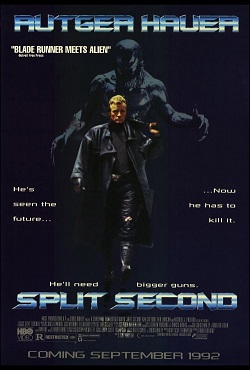
Split Second ↗ Wikipedia
Vision from 1992
Dir. Tony Maylam; Ian SharpUnited KingdomEnglishIMDb 6.090 min
dystopiaclimate changeenvironmental collapsebiotechnologyurban decay
In the year 2008, London has been transformed into a waterlogged, semi-submerged metropolis due to the catastrophic effects of global warming and perpetual rainfall. The city’s geography is defined by the failure of the Thames barrier, leaving the streets knee-deep in water and the sun permanently obscured by thick smog and pollution. This environment has fostered a rampant rat infestation and a general breakdown of urban infrastructure, creating a "warehouse future" aesthetic where the population lives amidst industrial decay and persistent dampness.
Societally, the world is depicted as being in a state of environmental collapse. Political gridlock is explicitly mentioned, with the film noting that proposed UN environmental measures were blocked by the United States—a cynical but strikingly accurate reflection of real-world climate diplomacy. The technological landscape is a regression; while advanced recombinant DNA exists within the film’s central antagonist, the everyday technology of the London police force remains grounded in bulky 20th-century hardware. The Earth is portrayed as a dying, overcrowded hub where the division between the elite and the "drowned" working class is bridged only by the shared trauma of a decaying ecosystem.
The film’s central prediction of massive, permanent flooding in London by 2008 was an aggressive acceleration of sea-level rise theories that did not manifest on such a timeline, though it correctly identified climate change as the primary driver of future geopolitical instability. While the psychic connection between the protagonist and the killer remains in the realm of speculative fiction, the film’s depiction of recombinant DNA—specifically a creature absorbing genetic material from multiple species—echoes early-90s anxieties regarding gene splicing and biotechnology. Retrospective analysis suggests that while the film's 2008 is far grimmer than the reality was, its portrayal of urban flooding serves as a potent, if premature, visual metaphor for modern climate concerns.