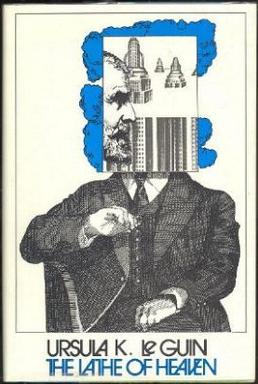
In the near-future of 2002, Portland, Oregon is depicted as a claustrophobic, decaying urban environment plagued by constant, toxic rainfall and extreme overpopulation. The world is a dystopian police state where citizens are subjected to mandatory psychiatric monitoring. This version of Earth is environmentally spent, characterized by a diminishing food supply and a sterile, gray aesthetic that reflects the protagonist’s internal trauma and the external societal collapse.
The central dynamic revolves around the Augmentor, a machine that enhances the "effective dreaming" of George Orr, whose dreams can physically rewrite the timeline. As Dr. William Haber attempts to use this power to "fix" the world, the Earth undergoes radical, jarring shifts: a global plague is triggered to solve overpopulation, and a benevolent alien invasion is manufactured to force world peace. These shifts highlight a divergence from our reality where institutional power attempted to solve 20th-century anxieties through direct, often catastrophic, biological and social engineering.
The film’s predictions offer a haunting parallel to 21st-century concerns. While we have not achieved reality-bending biofeedback, the depiction of a world reaching 7 billion people—a milestone reached in 2011—accurately mirrored actual demographic trends. The "solution" of universal gray skin to end racism serves as a metaphor for the loss of cultural identity in a globalized society, while the film's reliance on metaphorical visual effects due to its limited PBS budget ironically mirrors the "ghosting" and distorted perception often associated with modern digital disinformation and filtered realities.
What it predicted
biofeedback interfacesmass euthanasiaglobal pandemicneural augmentationuniversal racial homogenizationautomated state therapy