+10y
1975
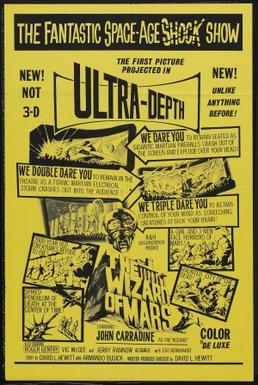
The Wizard of Mars ↗ Wikipedia
Vision from 1965
Dir. David L. HewittUnited StatesEnglishIMDb 3.478 min
space travelalien contactrobotsruinstelepathy
In the depicted 1975, Earth possesses the capability for manned missions to the Martian surface, utilizing multi-stage spacecraft and sophisticated remote surveying equipment. The film presents a future where automated biolabs are deployed ahead of human arrivals to determine planetary habitability, reflecting a logical progression of mid-century space exploration goals. However, the mission takes a surreal turn when a magnetic storm forces a crash landing, leading the crew to discover a Martian landscape far more active and ancient than expected, featuring canals, lava lakes, and the remnants of a once-galactic civilization.
The societal dynamics of this future Earth appear centered on scientific curiosity and space-faring expansionism. While the home planet is rarely glimpsed, the existence of "Earth Control" and the standardized roles of the crew (Captain, Scientist, Specialist) suggest a militarized or highly structured space program. The narrative implies a divergence from our reality where the Martian canals theory of the late 19th century was partially correct, though the civilization that built them has retreated into a self-imposed temporal stasis to "ponder" their destiny, existing in an eternal present within a cloaked city.
Technologically, the film accurately predicted the use of remote probes to survey Mars before human boots hit the ground, a milestone achieved by the Viking missions just a year after the film's set date. However, its more fantastical predictions—such as humans surviving on Mars by mixing ambient atmosphere with limited oxygen supplies or encountering telepathic collective consciousness—remain firmly in the realm of speculative fiction. The film's "prediction" of a 1975 Mars mission was overly optimistic by decades, as the actual 1975 was marked by the conclusion of the Apollo era and a pivot toward robotic exploration rather than the interstellar "golden road" depicted here.